
Airtel, Starlink bring satellite service to Uganda, second in Africa
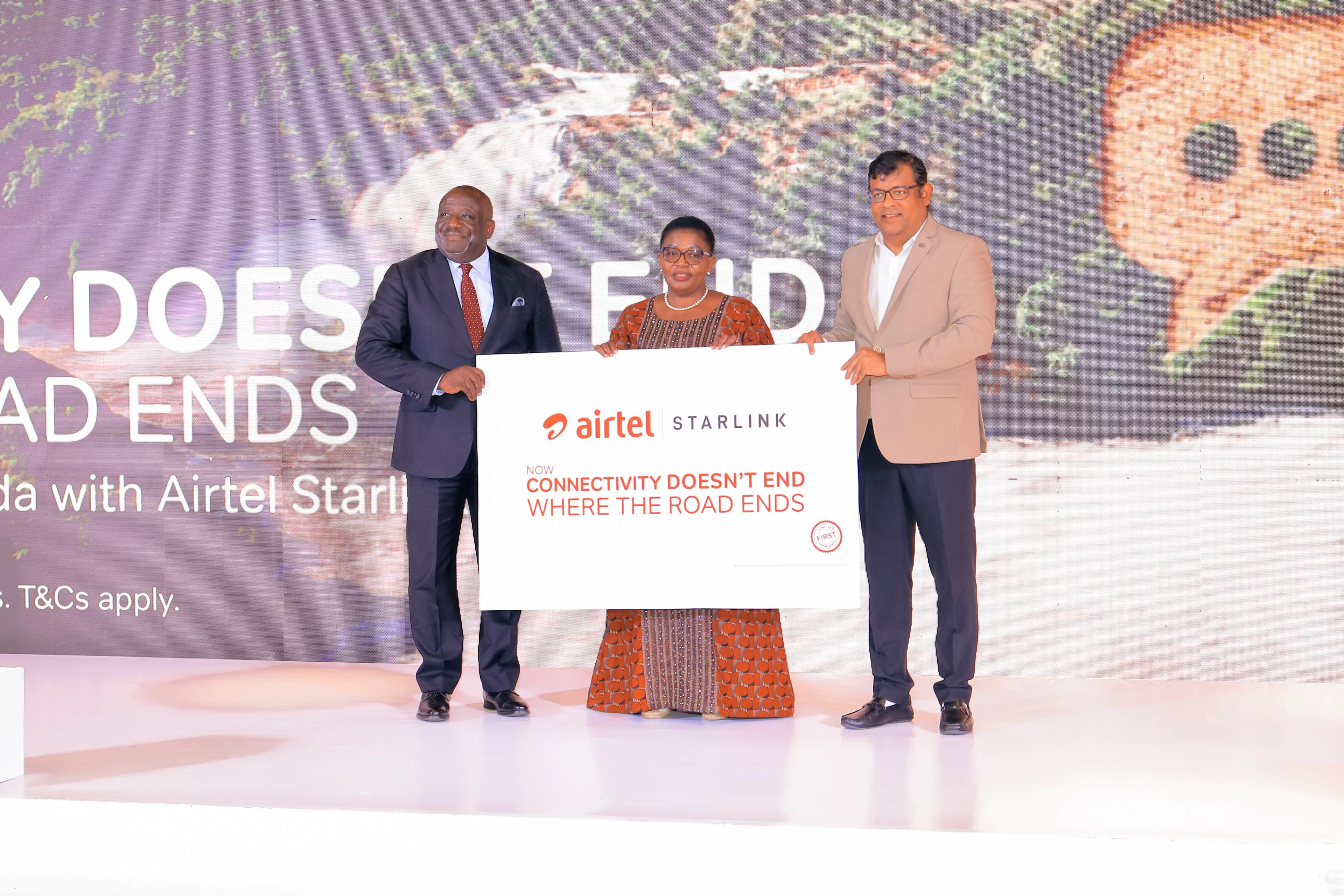
L-R Hon. George William Nyombi Thembo, the ED of UCC, Rt. Hon. Justine Kasule Lumumba, the Minister for ICT and National Guidance, and Som Soumendra, MD & CEO of Airtel Uganda, pose for a picture to officially launch the Starlink connectivity in Uganda in partnership with Airtel Uganda.
Airtel Uganda and Starlink have launched a satellite-to-mobile service that lets customers with compatible smartphones stay connected in places the terrestrial network does not reach, making Uganda the second African market to get the service after the Democratic Republic of the Congo, where it went live in August.
The service uses Starlink's constellation of 650 launched satellites and requires no dish or extra device, only a clear view of the sky. For now it supports light data uses such as WhatsApp messaging and SMS.
Eligible customers can register on the MyAirtel App for a free 30-day trial. After that, access will come through eligible Airtel Uganda data bundles.
Regulator: "We are not roadblocks to innovation"
Speaking at the launch, the Uganda Communications Commission's Executive Director said the regulator had in fact slowed the rollout. Airtel Uganda's managing director first approached the commission around November last year, but the request could not proceed because Starlink was not yet licensed, and an unlicensed operator could not carry a licensed operator's service.
A pilot in the game parks followed, which Airtel reported as very successful, and the go-ahead was given after consultation. The Executive Director said the regulator clears innovations once boxes are ticked on lawful interception, consumer protection, non-interference and fair competition.
The commission has, however, set tight conditions. Airtel must file performance reports every two weeks, which the regulator says will allow both sides to "learn together." UCC will keep monitoring quality, reliability and consumer protection.
Mobile operators are required under their licences to cover at least 90 percent of Uganda's geographical area, including islands, mountains and forests. The Executive Director said the obligation is technology neutral, so satellite is a welcome tool for reaching that goal.
Gaps remain in the north, lakes and west
Airtel Uganda Managing Director Soumendra Sahu said that even with the company's terrestrial investments, large rural areas still lack connectivity. Citing a GSMA report, he said 90 percent of the rural population is covered by 2G and 89 percent by 4G, and that gaps persist in the whole northern region, parts of the lakes and parts of the western region. He noted this is an industry-wide problem, not just Airtel's.
Sahu said Airtel Uganda has 20 million customers, all 3,700 of its sites are 4G, it has 584 5G sites covering more than 30 towns, and 12,573 kilometres of fibre. The company, listed on the Uganda Securities Exchange since 2023, has about 4,500 shareholders, and Sahu put its mobile services revenue at around 2.25 trillion shillings.
He said the satellite service is Airtel Uganda's latest first, after 3G in 2013, 4G in 2018, 5G and VoLTE in 2023, and an anti-spam service launched last year.
Who it is meant for
Airtel says the service should help transport and logistics operators, humanitarian organisations, health workers, farmers, mining operations and communities outside terrestrial coverage. It will also support communication during emergencies, natural disasters and temporary network outages.
Airtel Africa CEO Sunil Taldar said the aim is to complement terrestrial networks with satellite technology so customers stay connected wherever they live, work or travel. The launch builds on a partnership announced in December 2025, and Airtel Africa says further markets will follow, subject to regulatory approval.
ICT and National Guidance Minister Justine Kasule Lumumba congratulated Airtel and Starlink and said government's role is to build an enabling policy environment for private sector growth. She said the service supports productivity and connectivity in the economy, and noted that the partnership shows the spirit of the East African community lives on in pioneering technology.
UCC's Executive Director said even light internet is far better than no connectivity, adding that step by step "makes a bundle."